
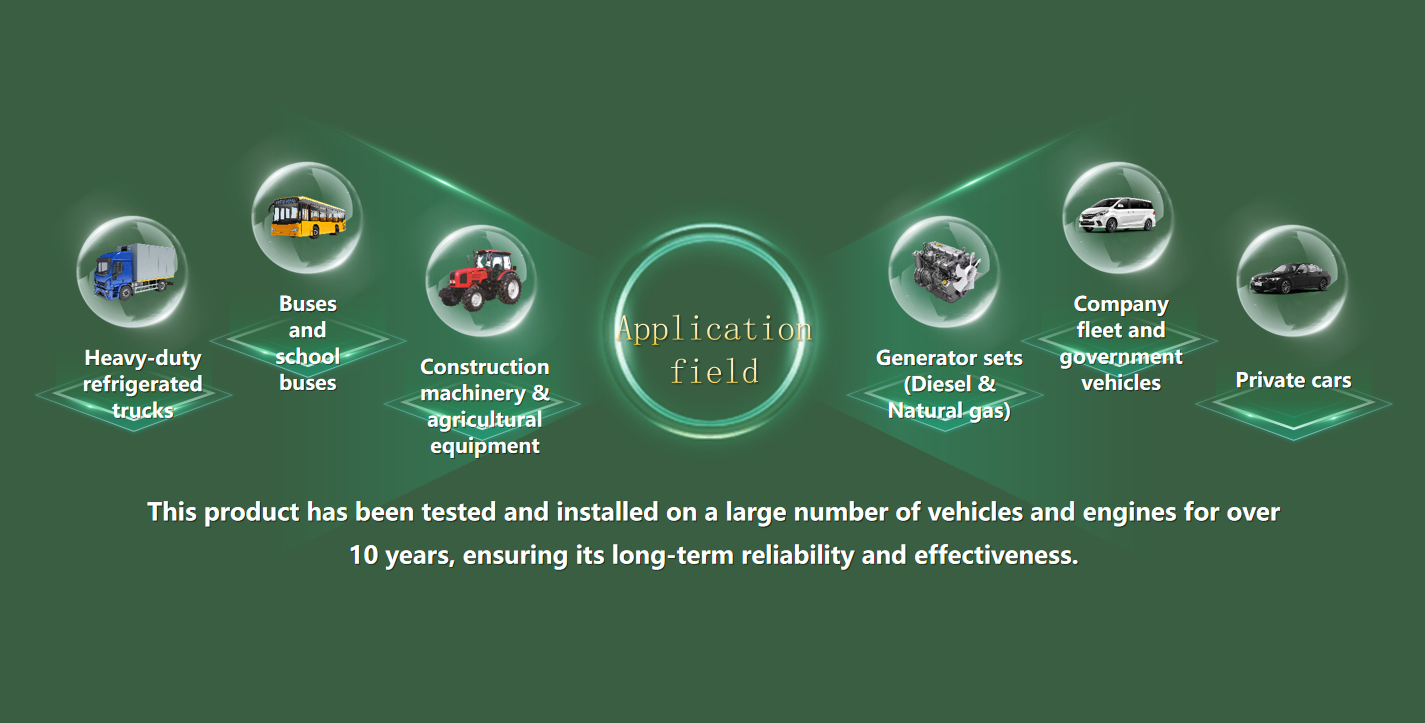
Applications
DAHENER
Applications
Heavy-duty trucks
Buses & school buses
Construction machinery
Agricultural equipment
Generator sets
Company fleets
Private vehicles
| Comparison Dimension | Traditional Water Injection System (e.g., Bosch) | Fuel Treatment Modulator + Air Intake Modulator | Working Theory & Efficiently Analyze |
| Physical Form | Water mist (visible droplets 10~50 µm) directly introduced into engine combustion chamber. | Fine cool mist (0-8 µm) | Much smaller particles generated by the device have a larger surface area, enabling instant and complete evaporation, absorbing more heat, far more efficient than partially evaporated droplets. |
| Core Working Mechanism | Physical cooling: Primarily lowers intake temperature through water evaporation absorbing heat. |
Physical + Fuel Modification Synergy 1. Cold mist evaporation increases air heat capacity ratio. 2. Reduces long-chain and increases short-chain alkanes in fuel. |
The two modulators work together, actively breaking down unburned hydrocarbon chains, fundamentally improving combustion efficiency and cleanliness, surpassing mere physical cooling. |
| Effect on Combustion Temperature | Lowers temperature, suppresses knock. | Significantly lowers temperature (up to 30%). | More efficient evaporation heat absorption and safer combustion work together to achieve superior temperature control, providing more room for advancing ignition timing to improve efficiency. |
| Effect on Emissions | Primarily reduces Nitrogen Oxides (NOx). | Significantly reduces all tailpipe emissions (up to 65~95%). | The two devices synergize to effectively oxidize Carbon Monoxide (CO) / Unburned Hydrocarbons (HC), Soot Particulates (PM), and Nitrogen Oxides (NOx), achieving comprehensive emission reduction, not just NOx. |
| Carbon Deposit Cleaning Ability | Limited (post-combustion chamber) | Efficient deep cleaning, from intake to exhaust, full range. | High ionization activity + extremely fine particle atomization continuously improves fuel decomposition and cleans combustion chamber, piston top, and valve deposits, which ordinary water mist systems cannot achieve. |
| Energy Consumption | Requires water pump, moderate energy consumption. | Very low energy consumption (3-15 Amps). |
The two devices have minimal power draw, meaning negligible burden on the vehicle’s electrical system, hardly offsetting the performance gains. |
Technological Level Difference
- Water mist system represents a macro-engineering solution.
- The Fuel Treatment Modulator and Emission Reduction Air Intake Modulator represent a micro-physical coordination solution that operates at the molecular level, providing a more precise and efficient approach.